

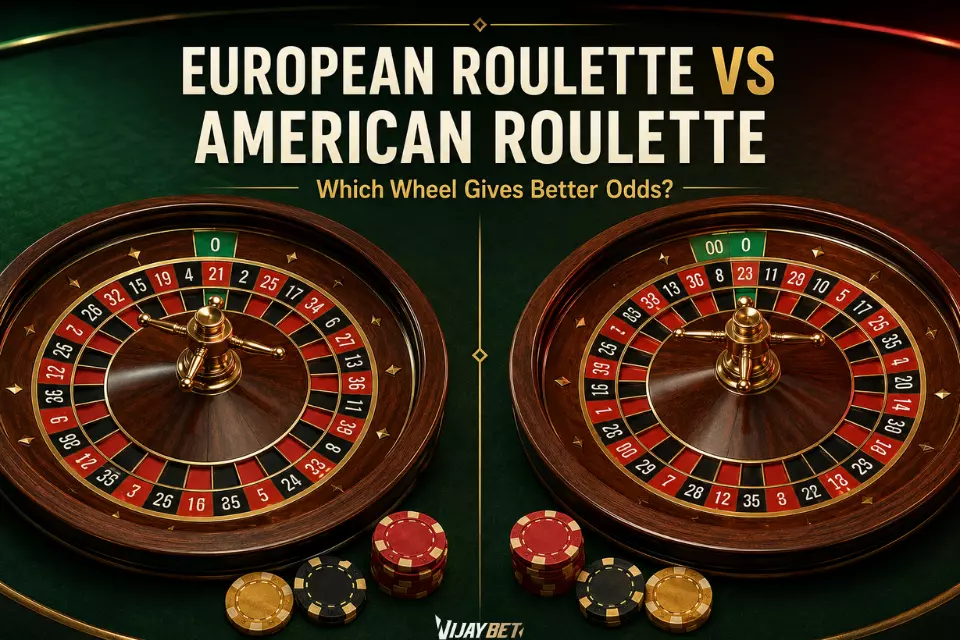
Open two Roulette tables on your phone and they may look almost identical. Both have red and black numbers, familiar betting areas and the same spinning wheel. The payouts also seem to match. A ₹100 bet on red can return ₹100 in profit, while a winning Straight Up bet still pays 35:1. It is easy to assume that choosing between the two versions makes little difference.
Then you notice the green pockets. European Roulette has one zero, while American Roulette has both 0 and 00. That extra double zero gives the American wheel one more possible result without offering a higher payout. It may be a small change to the table, but it affects the odds of every bet placed on it.
For Indian players browsing different online Roulette tables, this is worth checking before the first spin. A colourful design, quick dealer or low minimum stake may catch the eye, but the number of zeros tells you far more about the game you are entering.
European and American Roulette at a Glance
European Roulette has 37 pockets: the numbers 1 to 36 and a single green 0. American Roulette has 38 pockets because it adds a green 00. The main bets are almost the same, and most of them offer identical payouts in both versions.
| Comparison | European Roulette | American Roulette |
| Total pockets | 37 | 38 |
| Numbered pockets | 1–36 | 1–36 |
| Green pockets | 0 | 0 and 00 |
| Standard house edge | About 2.70% | About 5.26% |
| Straight Up payout | 35:1 | 35:1 |
| Red or Black payout | 1:1 | 1:1 |
| Five-Number bet | Not available | Usually available |
The extra 00 is not matched by a better return. A correct Straight Up bet pays 35:1 whether the player chooses one number from 37 possibilities or one from 38. American Roulette therefore asks players to accept an additional losing result while keeping the same payout table.
The difference is easy to spot online. If the wheel and betting area show only 0, it is European Roulette. If both 0 and 00 appear, it is American Roulette. Checking those two symbols takes only a moment and avoids choosing a table based on appearance alone.
One Extra Zero Changes Every Bet on the Table
Take a simple ₹100 bet on red. Both wheels contain 18 red numbers, but European Roulette has 37 possible landing positions. The chance of red is therefore 18 out of 37, or about 48.65%. American Roulette still has 18 red numbers, but the extra 00 increases the total to 38 pockets, reducing the chance of red to around 47.37%.
The same thing happens with black, odd, even, high and low bets. Neither 0 nor 00 belongs to any of these groups. On a European wheel, there is one green result that can defeat an even-money bet. On an American wheel, there are two. The payout remains 1:1 even though the American version has an additional losing pocket.
The difference on one spin may not feel dramatic. The ball can land on a chosen number in either version, and a short session can end with a win or loss regardless of the wheel. However, the double zero remains present on every spin. Over many rounds, accepting that extra pocket without receiving a higher payout becomes increasingly significant.
The House Edge Shows the Real Difference
Standard European Roulette has a house edge of about 2.70%, while standard American Roulette has a house edge of approximately 5.26%. In simple terms, the casino’s mathematical advantage is almost twice as high on the American wheel.
Suppose a player makes enough bets to wager a total of ₹1,000. Based on the long-term mathematical average, a 2.70% house edge represents an expected loss of about ₹27. With a 5.26% house edge, that theoretical figure rises to ₹52.60. These amounts do not predict what will happen in one session. A player could finish ahead, lose more or end close to the starting balance. The figures simply show how the two games compare across a large number of spins.
This is why the table with the most attractive presentation is not always the better choice. An American table may have a lively dealer, faster rounds or a lower minimum bet, but none of those features removes the 00. If two games offer similar limits and playing conditions, the single-zero wheel gives the player better mathematical odds.
The Payouts Stay the Same While the Winning Chances Fall
Most familiar Roulette bets are available in both versions. A Straight Up bet pays 35:1, a Split pays 17:1, a Corner pays 8:1, a Dozen pays 2:1, and red or black pays 1:1. The American wheel does not increase these returns to account for its extra pocket.
| Bet | Payout | European Roulette | American Roulette |
| Straight Up | 35:1 | 2.70% | 2.63% |
| Split | 17:1 | 5.41% | 5.26% |
| Corner | 8:1 | 10.81% | 10.53% |
| Dozen | 2:1 | 32.43% | 31.58% |
| Red or Black | 1:1 | 48.65% | 47.37% |
| Odd or Even | 1:1 | 48.65% | 47.37% |
| High or Low | 1:1 | 48.65% | 47.37% |
Consider a Straight Up wager on number 17. On a European wheel, 17 is one of 37 possible outcomes. On an American wheel, it is one of 38. A ₹100 stake could return ₹3,500 in profit on either table, but the European version gives that number a slightly better chance of appearing.
The gap also applies to wider bets. A Dozen still covers 12 numbers and pays 2:1, but 12 out of 37 is better than 12 out of 38. Players do not need to memorise every percentage before joining a table. The point is simpler: when the payout stays the same, fewer pockets produce better odds.
American Roulette Has a Five-Number Bet, but It Comes at a Cost
The American layout offers one wager that does not appear on a standard European table. It is known as the Five-Number bet, Basket bet or Top Line, and it covers 0, 00, 1, 2 and 3. If the ball lands on one of those five pockets, the usual payout is 6:1.
Covering five numbers, including both green pockets, may make this bet look useful. However, its house edge is about 7.89%, which is even higher than the standard 5.26% found on most other American Roulette wagers. The number of covered pockets is only half the calculation; the payout also has to provide enough value for the probability involved.
Players who want wider number coverage can already use Streets, Corners, Six Lines, Dozens or Columns. The Five-Number bet offers a different option on the American layout, but it does not solve the disadvantage created by 00. Its mathematical cost is actually higher.
Can a Roulette System Make Up for the Double Zero?
Martingale, Fibonacci, D’Alembert and Paroli are often discussed when players look for a more organised way to manage their bets. These systems decide whether the next stake should increase, decrease or remain the same after a result. What they cannot do is change the wheel.
A ₹100 red bet on European Roulette still covers 18 of 37 pockets. The same bet on American Roulette covers 18 of 38. Doubling the stake after a loss may increase the amount recovered after a later win, but it also increases the money at risk and does nothing to remove 0 or 00. A long losing run can push the required stake beyond the player’s budget or the table limit.
Previous results do not change this calculation either. If red has appeared six times in a row, black is not guaranteed to come next. If 00 has not appeared for several rounds, it is not suddenly due. Every spin produces a new independent result. A betting pattern may help organise a session, but choosing the lower-edge wheel has a more direct mathematical effect than changing stakes based on a streak.
Where Does French Roulette Fit In?
French Roulette also uses a single-zero wheel, so it is closer to European Roulette than to the American version. Some French tables include La Partage or En Prison rules, which may reduce the loss on qualifying even-money bets when the ball lands on zero.
Under La Partage, the player may receive half of an even-money stake back after a zero result. En Prison may hold the wager for the following spin instead of settling it as an immediate full loss. When these rules apply, the effective house edge on qualifying bets can fall to around 1.35%.
Not every single-zero table includes these benefits, and not every game labelled French Roulette uses the same conditions. The rules panel should confirm whether La Partage or En Prison is active. Players who only want a straightforward choice between the two common versions can still follow a simple rule: one zero is mathematically better than two.
Which Roulette Wheel Makes More Sense for Indian Players?
If European and American tables have similar minimum bets, speed and game quality, the European wheel is the stronger choice based on odds. It offers the same standard payouts with one fewer losing pocket and a lower house edge.
The minimum stake still matters. A European table requiring ₹500 per spin may not suit someone who planned to bet ₹100 at a time. Choosing a lower house edge does not help if the table limit forces the player to risk more than intended. A suitable table should combine a single-zero wheel with limits that fit the planned budget.
Live-dealer and RNG Roulette can both use European or American rules, so the format does not identify the wheel. Before betting, look for 0 and 00, check the limits and open the game rules. These details are more useful than relying on the table name or assuming every online version follows the same setup.
One Green Pocket Makes a Noticeable Difference
European Roulette and American Roulette share the same basic game, familiar wagers and standard payouts. The real difference is one green pocket. European Roulette has 37 possible outcomes and a house edge of about 2.70%. American Roulette has 38 outcomes and a standard house edge of around 5.26%.
The 00 does not prevent a player from winning a round, but it lowers the probability of every standard bet without increasing the payout. That makes the European wheel the more favourable option when the table limits and other conditions are similar.
Want to know more about Roulette games, wheel types and odds? Stay tuned to Vijaybet 11 for more updates.