

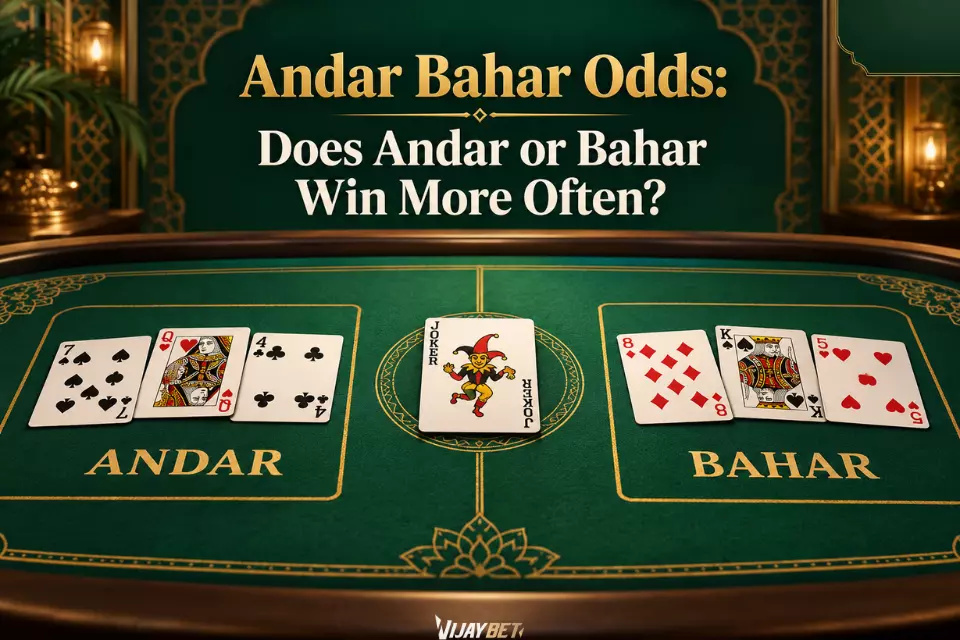
At first glance, Andar Bahar looks like a straight 50–50 choice. One side is Andar, the other is Bahar, and the first side to receive a card matching the Joker wins. Yet the maths is slightly more complicated because one side must receive the first card. That side gets the first opportunity to find the match, so the winning chances are not always divided equally.
This does not mean players should automatically choose whichever side receives the opening card. Online tables can balance that small advantage by offering a lower payout or deducting a commission. To compare Andar Bahar odds properly, players need to look at the dealing order and the payout together.
The First Card Creates a Small Advantage
Every round begins with one face-up card known as the Joker. This is not a printed Joker card. It is the reference card that decides which rank will end the round. If the Joker is a 9, the dealer continues until another 9 appears. The suit does not matter, so any of the remaining three 9s can become the matching card.
The dealer then places cards alternately on Andar and Bahar. If Andar receives the first card, it also receives the first chance to match the Joker. Bahar gets its first opportunity only after Andar has missed. The same pattern continues throughout the round: Andar receives the first, third and fifth cards, while Bahar receives the second, fourth and sixth.
This is why the opening side has a slightly higher chance of winning. If the first card goes to Bahar, the advantage moves to Bahar. The name of the side is not what matters; its position in the dealing order is.
Not every online table uses the same starting rule. Some versions begin with a fixed side, while others decide the starting side according to the colour or suit of the Joker. A player who always bets on Andar may therefore have the first-card advantage on one table but not on another.
If you are still getting familiar with the dealing process, start with Andar Bahar Online: How to Play and Choose a Side. Once the basic rules are clear, it becomes easier to see why a small change in the starting position affects the odds.
Better Winning Odds Can Still Produce a Worse Return
This is where many players make the wrong comparison. They look at which side wins more often but ignore what the table pays for that win. A small probability advantage means little if the return has already been reduced.
Suppose a ₹100 bet on Bahar pays 1:1. A correct bet gives you ₹100 in profit, along with the return of your ₹100 stake. If Andar pays only 0.90:1, the same winning bet produces ₹90 in profit. Another table may advertise 1:1 on both sides but deduct a 5% commission from one of them, leaving ₹95 in profit on a ₹100 win.
| Payout rule | Profit from a ₹100 winning bet |
| 1:1 | ₹100 |
| 0.90:1 | ₹90 |
| 1:1 with 5% commission | ₹95 |
These figures are examples rather than universal Andar Bahar rules. The actual payout depends on the provider and the table being played. What matters is the relationship between the chance of winning and the amount returned after a correct prediction.
For that reason, asking “Which side wins more often?” only answers half the question. A better comparison is: does the payout fairly reflect the advantage given to the side that receives the first card? The answer can change from one table to another.
Recent Results Do Not Change the Next Round
Live Andar Bahar tables often display a history of recent results. A board showing five Andar wins in a row can create two opposite reactions. Some players believe Andar is on a strong run and continue backing it, while others decide Bahar must be due next.
Neither conclusion changes the cards in the following round. Once the deck is shuffled, the result depends on the new card order, the Joker and the dealing rule. Five consecutive Andar wins do not force the sixth round to end on Bahar, nor do they prove that Andar has become more likely to continue winning.
The result board can be useful for checking what happened in earlier rounds, but it cannot show where the next matching card will appear. A visible pattern may look convincing after it has formed, yet there is no reliable way to use it as a prediction.
The same problem applies to betting systems. Doubling the stake after a loss, switching sides after every round or increasing a bet during a winning run may change the amount at risk, but none of these methods changes the probability of the next card. In particular, a doubling system can cause the required stake to rise quickly during a losing run. The player may reach the table limit or use up the planned budget before one later win can recover the earlier losses.
Side Bets Are Based on a Different Question
The main Andar and Bahar bets ask a simple question: which side will receive the matching card first? Side bets go further by asking when the match will appear, how many cards will be dealt or whether the result will fall within a particular range.
This difference matters because side bets should not be judged only by their advertised payouts. A reward of 10x, 50x or more may look stronger than a 1:1 main bet, but it is offered because the required outcome is harder to hit. A large possible return says nothing by itself about how often that return is likely to occur.
Some modern versions add several extra options. For example, Super Andar Bahar includes side bets and multiplier features alongside the traditional two-sided game. These additions can make the table feel more active, but they also introduce conditions that are not part of a basic Andar or Bahar wager.
Before using one of these options, players should read the paytable and check the RTP where it is available. The main bet and a side bet are not two different ways of answering the same question. They are bets on different events with different probabilities.
Which Side Makes More Sense?
When comparing Andar Bahar tables on Vijaybet 11, there is no fixed rule such as “always choose Andar” or “Bahar is safer”. The better choice depends on which side receives the first card and how much the table pays for a winning bet.
Before betting, identify the starting side and compare the payout offered on both options. If the side with the higher winning chance pays less, consider whether the reduced return removes the advantage. Commission should also be included in the comparison because the displayed payout may not be the final amount received.
It is also worth checking the minimum stake and table limit before the round begins. These details may not affect the card probabilities, but they determine how much a player can risk. Setting a fixed entertainment budget is more useful than changing the stake after every result, especially when a quick sequence of rounds makes it easy to lose track of total spending.
FAQs About Andar Bahar Odds
Not usually. The side that receives the first card has the first chance to match the Joker, so it has a small probability advantage. The table may balance this difference by reducing its payout or applying a commission.
No. The advantage belongs to the side receiving the opening card, and this can vary according to the table rules. Even when Andar goes first, a lower payout may make the comparison less straightforward.
No. A streak only records previous results. It does not affect the shuffled deck or determine where the next matching card will be dealt.
The Payout Matters as Much as the Winning Chance
The Andar–Bahar choice is not about finding one side that remains stronger on every table. It is about checking whether the small first-card advantage is fairly reflected in the payout. Without that information, the recent-results board cannot fill the gap.
Ready to choose your side? Join Vijaybet 11 today, explore its Andar Bahar tables and put your understanding of odds and payouts into practice. Check the table rules, set your budget and enjoy every round responsibly.