


Is baccarat a skill or luck? This is a common question among players trying to understand whether betting strategies can improve their results. In standard baccarat, chance determines the cards, while your decisions control which bets you place and how much money you risk.
This distinction matters when discussing baccarat strategies. Winning individual rounds or finishing a session ahead is possible, but no betting method guarantees consistent real-money profits. Useful strategies focus on understanding payouts, reducing avoidable betting costs and controlling financial risk.
Is Baccarat a Skill or Luck? What Players Can Actually Control
To answer “Is baccarat a skill or luck?”, it helps to separate the cards from your betting decisions. In standard Punto Banco, fixed rules determine how each hand develops. You cannot choose the next card, but you can control your bet selection, stake size and when to stop.
You Cannot Choose Whether to Draw Another Card
The main betting options are Player, Banker and Tie. “Player” and “Banker” are simply the names of the two hands. You can bet on either side.
The hand closest to nine wins. Aces count as one, cards from two to nine retain their values, and tens and face cards count as zero. Only the last digit of the total counts. For example, seven plus eight makes fifteen, so the hand is worth five.
Fixed rules determine whether either hand receives a third card. You cannot request another card because a total looks weak or refuse a card because you prefer the existing hand.
Skill Lies in Betting Decisions and Money Management
Your judgement still matters before placing a bet. You can check commissions, understand special payout rules, compare house edges and limit your spending.
However, these decisions do not change the cards in the next round. Bankroll management should not be confused with a method that guarantees long-term profits.
The accurate answer is that chance determines baccarat outcomes, while your decisions affect how much money you expose to those outcomes.
Baccarat Odds: Why Winning Probability Is Only Part of the Picture
Many players first ask which bet wins most often. However, winning probability alone does not show whether a bet offers reasonable value. You must also consider the payout and the house edge.
Comparing Banker, Player and Tie Bets
The following figures apply to standard eight-deck baccarat. Under normal rules, Banker and Player bets are returned when the result is a Tie.
| Bet | Probability of winning a round | Net payout on a winning bet | Approximate house edge |
| Banker, with 5% commission | 45.86% | 0.95:1 | 1.06% |
| Player | 44.62% | 1:1 | 1.24% |
| Tie, paying 8:1 | 9.52% | 8:1 | 14.36% |
| Tie, paying 9:1 | 9.52% | 9:1 | 4.84% |
Under these conditions, Banker has the lowest house edge. Tie offers a bigger payout, but it also wins much less frequently. A larger potential prize does not automatically make a bet better value.
The commonly quoted 14.36% house edge for Tie applies to an 8:1 payout. When Tie pays 9:1, the house edge is approximately 4.84%. These figures should not be used interchangeably.
House Edge Is Not a Fixed Charge for Each Session
With a house edge of approximately 1.06%, Banker bets produce a theoretical average loss of about ₹106 for every ₹10,000 wagered.
This does not mean you will lose exactly ₹106 each time. It is also not an additional fee deducted by the platform. It is a long-term mathematical average based on the probabilities and payouts.
The calculation uses total money wagered, also called turnover. Betting ₹100 over 100 rounds creates ₹10,000 in turnover, even if you started with a smaller balance and repeatedly used the same money.
Common Baccarat Strategies: What Can They Actually Achieve?
Banker betting, Martingale and the 1-3-2-6 system are frequently discussed as baccarat strategies. Some change the bet you select, while others change your stake. None removes the house advantage.
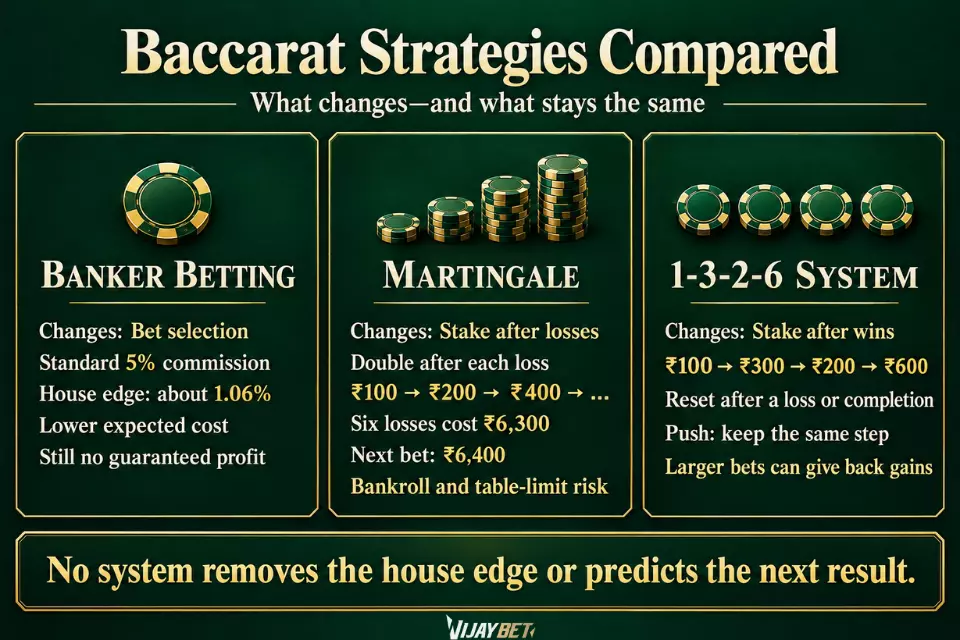
Banker Betting: Choosing a Lower Expected Cost
Under standard rules with a 5% commission, Banker has a slightly lower house edge than Player. Among the main betting options, it therefore has the lower theoretical cost.
However, consistently backing Banker is not a prediction method. Banker can lose several consecutive rounds, and a lower house edge does not guarantee a profitable session.
Check no-commission tables carefully. Some reduce payouts when Banker wins with a particular total or introduce special push conditions. The words “no commission” alone do not establish better value.
Martingale: One Win May Not Solve Every Loss
Martingale usually involves doubling the stake after each loss, with the aim of recovering previous losses on the next win.
Starting at ₹100, six consecutive losing bets would be ₹100, ₹200, ₹400, ₹800, ₹1,600 and ₹3,200. By then, the total loss would be ₹6,300, and the next required stake would be ₹6,400.
An insufficient balance or a table limit can prevent the next bet. Banker’s 5% commission also means that simply doubling does not always recover every previous loss plus the intended profit.
Martingale should therefore not be presented as a quick recovery method. It increases the amount at risk without improving the next bet’s winning probability.
The 1-3-2-6 System: A Fixed Sequence Does Not Mean Fixed Risk
This system uses stakes of one, three, two and six units following successive wins. A common version returns to one unit after a loss or after completing the sequence. A push leaves the current stage unchanged.
With a ₹100 unit, the sequence would be ₹100, ₹300, ₹200 and ₹600.
Unlike Martingale, it increases stakes after wins rather than losses. However, the final six-unit bet can still give back a substantial part of the earlier profit.
It should not be described as a steady-profit strategy. Changing the stake sequence does not change the underlying probabilities or payouts.
Bonuses, Spending Limits and Live Baccarat: Common Misunderstandings
Promotions and game formats are often presented as ways to improve results. Each needs a separate assessment because none automatically increases your winning probability.
A Bonus Balance Is Not Necessarily Withdrawable Cash
Where participation is lawful, check the wagering requirements, eligible games, contribution rates, expiry dates, maximum stakes and withdrawal conditions before accepting a bonus.
For example, a ₹1,000 bonus with a 30-times wagering requirement on the bonus alone requires ₹30,000 in qualifying wagers. If baccarat contributes only 10% and is eligible, the actual baccarat turnover required would be ₹3,00,000.
The bonus amount alone does not show its value. The required turnover and conditions that could invalidate the reward matter just as much.
Loss and Win Limits Are Stopping Rules
A loss limit or win target sets a condition for ending a session. Its purpose is to reduce the influence of emotions on spending.
However, no fixed percentage suits everyone. There is also no formula under which stopping at a particular profit guarantees long-term earnings. You may not reach that target before suffering losses.
The concern is repeatedly raising a limit after losing or placing additional bets because the target feels close. A spending limit cannot serve its purpose if it keeps changing during play.
A Live Dealer Does Not Automatically Prove Fairness
Live baccarat shows physical cards being dealt, while digital versions use software-generated outcomes. A human dealer alone does not establish fairness, and using an RNG does not automatically mean results are manipulated.
Relevant checks include regulatory oversight, testing, clear rules and complaint procedures. For example, the UK Gambling Commission sets technical requirements for acceptable randomness in games under its regulation.
This shows that RNG games can be subject to fairness standards. It does not verify or endorse any particular platform.
Conclusion: Understanding Strategy Matters More Than Finding a Winning System
Baccarat can produce short-term wins, but no reliable method guarantees consistent real-money profits. Under standard commission rules, Banker betting offers a lower house edge, while bankroll management helps limit spending. Betting systems change stake sizes, but none can predict the next result.
Understanding these limits helps you make informed decisions. Treating Martingale, betting patterns or bonuses as a dependable income plan can turn temporary success into unrealistic expectations.
Explore more baccarat insights with VijayBet 11, from game rules and payouts to the limits of popular betting strategies. Make informed choices and keep every stake within your budget.
Frequently Asked Questions About Baccarat
Roadmaps and streaks show previous results, but they do not reliably predict the next winning hand. A run of Banker wins does not mean Banker will keep winning, nor does it mean Player is due to win.
In standard eight-deck baccarat, Banker wins approximately 45.86% of all rounds, slightly more often than Player. With the usual 5% commission, Banker also has the lowest house edge among the main bets, although it can still lose several rounds in a row.
No. Doubling after each loss quickly increases the required stake, and your balance or the table limit may stop the progression. Banker commission also means a winning doubled bet may not recover all previous losses plus your intended profit.
Baccarat is not a dependable source of regular income because standard bets carry a house advantage. You may finish individual sessions ahead, but those wins do not establish a reliable earning pattern. Bankroll management limits spending without guaranteeing profit.